Showing posts with label philosophizing. Show all posts

filling up or filling out


Untitled
Originally uploaded by quiet.fyre
Lately, I've been eavesdropping on a lot of people talking about greatness. Toronto is a magnet for ambition, and for people who thirst and strive for greatness. I started asking myself if that was something I strove for and the answer came back a very resolute NO. I don't want to be great. I just want to be whole.

It's the difference between growing in a line and growing in layers; filling up and filling out. I don't care for the greatness of stuff, the greatness of ego and self-importance- really, I'd like to trash that whole show. I hate capitalism in part because it engenders this very idea of greatness. I never want my sense of self to be tied to my job title. My thirst is for something different. I want to feel... full. My life choices are all about making me feel this intangible fullness, wholeness, satiated with ideas and knowledge and never-befores...

I keep waiting for reality to kick in, to realize I'm old and need to be making more soberingly responsible decisions... but it hasn't happened yet. I think I'm going to ride this out as long as I can. I hope the world can live with that.

Hannah and Me vs. The World

I am a shit talker. I love telling stories- about myself and about the world- and when I'm talking about anything, in any context, about anyone, you can be sure that it's really just all about me.

Consequently, when I interact with others, I can't help but assume that they too are wrapped in self-reflexive sticky tape, and that the whisper of insight I glean from our interaction is a small fraction of the scream they intend to communicate. This is pretty much my working assumption with all attempts at communication- I don't know you; I can't know you; I can only know the you in me and that you is a story I've crafted through careful detective work laden with my own subjective bullshit.

So I find it pretty amusing that I've somehow found myself dating someone with an unshakeable faith in words; who firmly believes in the importance of classification; who has an aversion to narrative; who is happy to see a spade as a spade, whosoever should call it so. All this talk about talk brought me back to certain ideas that I used to circle around a lot, and back to Hannah Arendt. Last year, while writing an article for work about Women and Philosophy, I discovered Arendt's The Human Condition, and found all my thesis ideas articulated by A Famous Person, which made me feel both cheap and unoriginal, and immensely privileged to be philosophically aligned with A Famous Person.

Hannah (The Famous Person with which I am aligned and thus can casually refer to on a first name basis) and I both agree that understanding people through their words is about as exact a science as meteorology- you can amass as much evidence as you want to support your assertion that x is x, and you can devise your plan of action accordingly, but it simply may not be so. We all know this (duh, people are complex) but we sometimes don't recognize how much of our actions and interactions are based on these quick fix placeholders. We are in love with our nouns; intangibles don't sit well with us. So, to get through life without having our heads explode in the ideological netherworld, we say "ok. I know x is not exactly x, but let's assume it is... for the moment" and then we plan our counter-actions accordingly. But the assumptions build on more assumptions, and the placeholders of ourselves become the charicature stand-ins in our shared reality with others.

In Hannah's words, there is a distinction between "who" we are and "what" we are; and words can lead us only to the what: "The moment we want to say who someone is, our very vocabulary leads us astray into saying what she is; we get entagled in a description of qualities she necessarily shares with others like her; we begin to describe a type or a character... with the result that her specific uniqueness escapes us" (The Human Condition, 181).

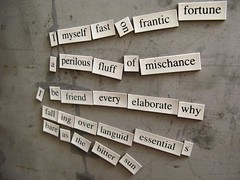
This is why I put all my words in brackets, and why I like fridge poetry, anecdotes, rants without context, exquisite corpsey writing and non-sensical non-sequiters. Language to me is about codification, so I figure, if I can confuse the law that language governs; if I can use words in ways they aren't meant to be used, then maybe I can reveal more of myself. If I don't name my truth, it forces you to fill in the blanks with your youness, and maybe that will lead you to it via the scenic route. That mystery and revelation, that intangible moment in between, is honestly what most humbles me about being with and among other people.

Ok, let's leave that for now. Let's just frame this conversation in simpler terms- objectivity and subjectivity. Hannah talks about our subjective selves, and about a) how we relate to the common things and stuff of our shared world and b) how we relate to each other. She calls these relations "in-betweens" and says this:

Action and speech go on between men, as they are directed toward them, and they retain their agent-revealing capacity even if their content is exclusively objective, concerned with the matters of the world of things in which men move, which physically lies between them and out of which arise their specific, objective, worldly interests. Most action and speech is concerned with this in-between... most words and deeds are about some worldly objective reality in addition to being a disclosure of the acting an speaking agent.
[Another in-between] consists of deeds and words and owes its origin exclusively to men's acting and speaking directly to one another. This second, subjective in-between is not tangible, since there are no tangible objects into which it would solidify; the process of acting and speaking can leave behind no such results and end products. But for all its intangibility, this in-between is no less real than the world of things we visibly have in common.
The Human Condition, 182.

To better explain this to myself, I drew a diagram (the conical shaped things on the sides [that look like tadpoles] are actually supposed to be eyes).


Figure A. illustrates how we relate to "worldly objective reality", you know, my red isn't the same as your red etc. Figure B. illustrates how that simple subjective premise is amplified when you're dealing with and reflecting back a whole other set of subjective filters. The effect is akin to holding a mirror up to another mirror- it's an endless strange loop of interpreted and reinterpreted subjective baggage and poof! brainfuck!

How do we resolve this? How the hell, then, can people understand and relate to one another? I feel like the answer is two-fold: look in and act out. One of the most profound analogies I've ever heard came from a live Saul Williams event at Glendon campus a few years back. He was talking about connecting to people, and he said there are 2 ways of going about this. He said

I can relate to you all in one of two ways. I can do it by looking out, and saying 'oh, he's dark like me, she's dark like me, we're connected'. Or I can relate to you all by looking in, right? By looking in, I feel a greater connection. It's like I have a well in my backyard and you have a well in yours. We both go to our seperate wells to get the water, but the source of water is the same, right? So that the deeper you get within yourself and getting to know yourself, like you transcend selfishness and go to the point of community where you have a complete understanding of your interconnectedness with every single living being and organism on this planet. And that's fucking enlightenment.

This, to me, is the starting point. With every social interaction, we should come into the conversation knowing that we're really (in a cynical sort of way) just talking to our own reflection.* That this "ask and answer" just happens to necessitate another body to help you in understanding yourself better. This may sound unconscionably self-serving but I actually think it can be very symbiotic- we are helping each other recognize ourselves more fully; to dig deeper inside to find the source material from which we are all made; to touch the intangible in-between Hannah refers to.

We are all made of the same "stuff", but how we articulate that- the patterns we weave with that universal source material, this unique and unrepeated design called the Self- is infinitely complex. So here comes the second part- I've always thought that the greatest gift you can give the world is to keep articulating who you are and why you are to everyone you encounter. In turn, I also think the most beautiful and humbling part of talking to people is trying to understand who they are and why they are, and this process- of recognizing how we have drawn from the universal "stuff", how we've taken from it or how it has taken from us to weave a unique life experience- this is how we connect.

Hannah and I both agree that the most beautiful thing about humanity is its ability to collectively reflect on both the sum and its parts. Hannah calls it "the paradoxical plurality of unique beings," and that is exactly how I understand the idea of community. Only by screaming out your own subjectivity can you arrive at an honest point of connection*, and it's this gift of difference that we can all collectively draw from, revel in. "Speech and action reveal this unique distinction. Through them, men distinguish themselves... they are the modes in which human beings appear to each other... This appearance rests on initiative, but it is an initiative from which no human being can refrain and still be human" (The Human Condition, 176).

Ok, this is long and rambly and I've only told you half of Hannah's story (or my story about Hannah and all this other stuff I thunked up) Hannah actually talks a lot about actions... and I've managed to say an awful lot about saying things and nothing about doing stuff.

So I'll end with a reflective observation about me and action. Hannah uses this term called praxis, simply put praxis is the process of gathering your reflections and ideas, and giving them life- putting your ideas into action.

Here's what I'll say about praxis. I use Firefox's "save and quit" function to keep all my existing tabs open, so that the next time I turn on my laptop, I have several tabs staring back at me, reminding me of what my focus/interest/obsession was from the day before. Some of these tabs have been hanging about on my computer for some 10 months- no joke. Here are my tabs:

1. reroot organic CSA, internship information
2. "Make Radio", This American Life
3. Transom.org- Ira Glass interview on making radio docs
4. My own tarsier photo on flickr (to remind myself I want to print it out)
and, newly added
5. Wikipedia definition- praxis

Ahem. I done praxis dem sludam** wicked well. Big up Hannah to the massive...

* You don't have to agree with me. I don't even know if I agree with me... but here's another paraphrased quote to excuse everything I've said: "Things go through me. And if I am individual it is because these threads are knotted together in this particular time and this particular place, and they hold."

** sludam is plural for sluts. I learned that from a Teen Slang expert
messy thoughts [subject to ifs, buts and takebacks]

Every Chinese character has a story. Often a long, meandering story, rich in symbolism. The charcter for "female" depicts a woman kneeling in submission, and the character for "tranquility", is the female character under a house. Whoever invented these characters, they assumed that the story was a universal kind of truth. they didnt realize how subjective the story was. In some cases these stories become values frozen in time. They outline a narrative that Chinese people are culturally subserviant to, but will continue to identify less and less with.

There is something about this logic that reminds me of myself, though i cant quite put my finger on how. It has something to do with being needlessly complicated, with getting caught up in the details... with being consumed by my own subjectivity. I guess the Chinese way of thinking is just really bloody neurotic- everything means something, and the thread of meaning runs deep. You end up getting stuck in some all-encompassing history that's not even yours.
Like using all these ideologically-outdated characters to narrate your reality today. Sometimes things are just coded in ways that I don't relate to, or understand.

We are saddled by our upbringing, by whichever way we were formed. If we grew up feeling negative, its easy to lean towards negativity. If at first we give too much, it's hard to learn how to be selfish later. If we were raised to be conservative, it's impossible to feel fully free.

A few years ago, I was on a personal mission to figure out the difference between habit and instinct. My argument was that there was no difference; that habits are instinctual. They are disguised as natural reactions, but in actuality, they are learned, and so can be unlearned. So, pumped by this new revelation, I took an inventory of all my habits, my long list of bad behavior and I started to unpack. I can't exactly remember what was going on in my life at the moment, but I was convinced that it was something happening collectively, to me and the people closest to me. I had an image of all of us packing up all our baggage, and jumping off a cliff. The lightest of us would fly while the pack rats would fall, like a test to see if we could change with the times.

Lately, I've been arguing against that me. I feel old, and now I'm thinking- for better or worse, this is it. This is me. I'm not trying to sound defeatist or anything, seriously, far from it. I just don't believe in giving myself shit for who i am anymore. It just... is. I'm ok with this, I'm more than ok. I like me [what up, Stuart Smalley]. This pretentiously-titled blog is referring to this strong belief I have in staying open to change; not being afraid to think or feel or do something outside of my comfort zone. But all that doesn't mean a thing if it doesn't have a home base. We are free to re-draw ourselves, but, like it or not, it will always trace back to something familiar, and it should. And that homecoming... it's a niiice.

Talkin' shit - Hannah Arendt, action, speech and tangents galore

I started writing a short article on Women in Philosophy for work, and I stumbled upon some ideas from Hannah Arendt that really struck a chord. (sorry im starting to use really cliche idioms, but its kind of an inevitable drawback of working for an ESL magazine... we're training all the non-english speakers of the world to sound like Mr Dress-Up... by golly)
Arendt's known for her political philosophy, her most famous piece of writing is probably Origins of Totalitarianism, but the ideas that really resonated with me were from The Human Condition. Mostly because some of her ideas were things that I thought I'd thunked up on my own... [I don't want to sound like a pompous ass, but that happens to me a lot. Like, I philosophize, I practice the rant, and then I realize that it was actually Someone Famous' rant that I've accidentally plagerized, and Someone Famous has not only said it first, but better. But then I think, hey, Someone Famous agrees with me. And I feel really cool, and better about it all. and so forth.]

Arendt theorizes that every action mimicks the act of being born. That is, in every action we have a chance to break out and do something completely new and unexpected. She gives these actions a kind of reverence, like in action lies freedom; you are never more free than when you do something unexpected. And because you are you, and only you can be you, the actions that you bring into the world are a unique and special miracle.
Ok, here's where it starts to get eerily similar. Arendt also says that your actions are a reflection of your self, but that they only matter in the context of the whole; the community. Because we are human, we use the same apparatus to understand each other, and we want to understand each other. But because we are individual, we each act and relate to each other in unique ways. And with our unique wells of experience, we can forge new networks of understanding, new ways of relating, infinitely complex and unpredictable. Our individuality, our sense of self is the driving force behind all this possibility.

She talks about the importance of speech, that it's the story that makes the person; that seals the identity. Stories live and actions die, so to preserve it, we perform an action, then we tell a story to describe the significance of that action. This happens in history all the time, and there's something really cynical about it.. but we won't get into that.

All this got me thinking about how I use speech in relation to action and identity, and I realize that it's massively important. I have a ridiculous capacity to talk shit. I talk too much. I say more than anyone EVER needs to hear. About everything. Anyone whose ever dated me can readily vouch for that.

Ok, actually, that was a tangent. i really wanted to to talk about narrative. The story is incredibly important to me. Before and after my actions, but especially before. It took 10 years of talking about travelling before I was ever able to leave. When I wanted certain jobs, or career paths, I had to talk myself through it; I had to speak to make it happen. I had to articulate what I wanted to myself, over and over again. Same thing with bad habits, old ghosts of me. I have to tell myself to change, I have to isolate the infection with my words.

The story enables the action, hell, sometimes the story IS the action. In my early 20s, I used to think that I could substitute one for the other. Whenever I was angry with people, I would just tell myself a story- resolve conflicts in neat packets of inner dialogue, without the fuss of confrontation, and declare the matter settled. Which is fine... if everyone in the world was just a figment of my imagination. But ho, looky here, people exist.

Narrative after the fact is also important, but less so. i have a shitty memory, and only a partial understanding of the "now", so most of my cards are stacked for the future, which is why speaking things into action is so effective for me. Usually, memory comes down to binary experiences- I file things in the memory bank as either "good" or "bad". Details don't stick unless I've made a point of crafting them into a story, then it becomes a mixture of memory and narrative, which is arguably all we have access to anyway. We immortalize ourselves. In every living moment, I'm a story waiting to be told later. And Im not the only storyteller. Every time any of us tell a story about a friend; about each other, we make ourselves all the more solid, we become more material. I whisper stories about you all the time, I carry you with me everywhere. You are material to people you haven't even met.

Ok, so speaking of Someone Famous paraphrasing me... i just watched My Blueberry Nights last night, Wong Kar Wai's latest. So in keeping with stories, me, you and me again, here's a line:

Sometimes, we depend on other people as a mirror
To define us and tell us who we are.
And each reflection makes me like myself a little more.

bad poetry, and the paradox of sense

i just found this in the midst of sorting files... it was a poem I wrote for a Dada and Surrealism class. Actually, this isn't the poem, this is part of a paper I wrote to explain the poem. I ran out of things to say about the stupid poem so in the midst of some academic bullshitting, I started ranting about a midget and a goat... which has actually become a prevailing surrealist theme in my life. Even after all these years, I can still tell which parts are obviously contrived... I bet you can too. I don't know why I'm putting this up, I was just like "oh yeah! the midget and the goat! I remember that!". i think it's just an excuse to go on some rant about random order... so maybe you should skip the poem and go straight to the end part.

In more inopportune times, there would only be the goat to thank, but thankfully, it didn’t appear that sanity was bleeding. Horribly disfigured, perhaps, but in essence, I always presumed him to be anarchic in his depiction of the modern burlesque. For the more feeble-minded, an itinerary of degradation would be in order for the convalescence of dear Samson, whose little midget body has suffered the worst slings and arrows of insults. I never realized the extent of his pain- I was bleeding, after all. And it didn’t seem to matter that the clock was ticking backwards, or that the elevator failed to elevate me. Something was missing. It wouldn’t have occurred to me otherwise, but I happened to be sitting at the time. So I grabbed the little midget by the arms (not realizing that the limbs had become autonomous to what was left of the body). I shook it violently and I said “I renounce sanity! Madness is real! To be mad is to be natural!” It was more than she could bear, but I was compelled to do it. For my own part, I had none. Someone had already taken the ferris wheel to the rodeo, had already drawn the superfluous nipple on the Venus, had already bit and barked at the Pope while he drove away in his golf cart. All I could do was applaud the fact that it was funny.

... it occurs to me that I've always loved writing this way. all equisite corpsy-like and autonomation styles. It's why I love fridge poetry too. it's so nice not to have to make sense. Or to make sense in a really nonsensical way. All my fridge poetry makes perfect sense, it just makes it's point via a dizzyingly circuitous path. Here's my theory:

Fridge Poetry is like Vipassina Meditation.
and furthermore...
Vipassina Meditation is like having a box over your head. (stay with me, here). You are confined by a very specific and somewhat arbitrary set of rules; you have very finite limits and you learn to function within the confines of these limitations, this box. You learn to be happy with a little. So that, when you remove the box, you can truly appreciate the space around you, and use it to its fullest potential.
Fridge Poetry is the same- you have a finite set of words, you learn how to use them wisely, in ways they are not intended to be used, but in the end, they work. They more than work. They say more things in the wrong places than they would if used conventionally.

Ipso facto ergo.... Anita knows how to make a beautiful mess of things.

meaning in the moving design

Happy New Year! If this entry seems muddled, you can blame it on sleep deprivation....

let's try explaining the title here. I'll start by quoting something I wrote in my journal when I was 15 years old. I said "My purpose in life is to understand what it means to be human". I don't think I knew what the fuck I was talking about back then, I just knew it sounded pretty and left it at that... so am I more or less pretentious now, because I actually believe that line, and really feel like that's what my life's about?
Ok, so I'll describe myself here as passively self-absorbed, which in layman's terms, really just means I'm neurotic, and in positive-spin terms, means that I devote a lot of time to my Self as a project- figuring out who I am, why I am and what I can be if I knew the answers to the first two. I find these questions fascinating, not just in the context of me, but in everyone I meet, and how they have come to be the person that they are. And because I think about it so much, I also have really high-fallutin' ideas about how this thing called the Self comes to be.

Imagine the action of drawing an infinity symbol. I liken our lives to the constant retracing of the design- always moving, finding new experiences, changing or tweaking our characters, but always circling back on the same design. taking all the new stimulus and showing it to the older parts of ourselves and seeing what fits. And just as on paper, when you retrace the same design over and over again, the first few tracebacks looks flimsy, like you can blow them off the page. But after a while, it becomes solid, it has weight; it is meaningful despite the flux of change, or maybe even because of it.

Each one of us is a complex set of genetics and circumstance. There are finite things things that we are born into (sex, age, genetic dispositions). There are social givens (birth order, family dynamics, class, race). And there are the things in between, the experiences that happen to you and you alone; that are given more or less weight because you are who you are; that changes your beliefs and values in big and little ways; that frame your perspective for other experiences that may not otherwise mean anything to you. We are at each moment looking ahead and behind- our history frames the way we interpret/absorb new stimulus, and in turn, that experience reshapes the way we will frame our next experience.

And when I say stimulus, I guess I could be talking about a bunch of things, but mainly I think I'm talking about people ie. the way I interact with others, or what I see in the way people interact with each other. I think of everyone I interact with as a mirror to myself- they reflect me, but the interaction is a constant play of our respective selves, a moving feedback loop.
Example.
I'm starting a conversation with someone, let's call him Ike. I'm being 'me', but Ike is seeing the 'me' in him; his interpretation of me is mixing with all his Ikeness. And then, as we interact, he is spitting that new 'me' (the Ike-ified 'me') back out at me, and I begin to see Ike's 'me'. And maybe Ike's 'me' and my 'me' have a little joust; maybe a love affair, but more often than not, they just kinda stand awkwardly beside each other and suddenly there are two 'me's. And three and four, and so on for every person I meet.

We all know this intuitively. One group of friends may see us as one person, another group as someone entirely different. We'll play up certain parts of our personality for certain people, hide things for others. All true, every Self a true self. I don't speak to any of my high school friends anymore, but when I did, I always felt like they were speaking to the 15-year-old-me, and I would have to confront the teenage me in all of our conversations. Now that I don't speak to them, I get anxious because I feel like I've erased part of my past, because I no longer have any 'mirrors' to tell me who I was.

I suppose there are good and bad aspects to this, but for the most part, the strange loops benefit me. People... generally like me, and so the strange loop reminds me of things that I sometimes forget I am, or it gives me confidence in certain qualities of myself that other people see, but I can't. In darker days, when I had anxiety attacks, I would always seek out a friend to 'watch me'. They didn't have to speak to me, I just couldn't be alone. I needed someone who knew me to... affirm my existence or something. I had no 'inner eye', I needed someone around who could see me, because I couldn't see myself, and I would have this crazy fear that if no one was around, that I would disappear. or something.

But the best part is being able to read the subtext- figuring out who they are by what they think I am (... catch that? yeah that's right, I'm onto you)

So this is learning at its root for me. I am a learning sponge, and everyone I meet is my teacher. My project is the study of my Self, and by extension, the study of everyone else, because we are connected. People affirm my existence, and people are the well of experience that constantly remake me. When I meet people, the philosophical pretense is always like "ok, who are you and what can you or your life teach me about me and my life?". It sounds like a heavy burden but it's not. I just like listening to people talk about their lives. And I like listening to people think about their lives as they're talking about it, like eavesdropping on the self-reflective moment. On the selfish tip, I secretly think that how other people live will lead to some small insight about my life. And if not, well, at least it was an interesting story.

... introduction

how do people start these things?

ok. by way of introduction, I will now list off various idiosyncrasies I had as a kid, and/or things that I inexplicably still hold true to this day:

  • I always had to wait until the toilet stopped tinkling before I brushed my teeth, for fear that the water pipes would get mixed up and I would accidentally be brushing with pee water
  • I refused to call anyone on the hour or the half hour, because I didn't want anyone to think I had waited until exactly 9-0-0 to call them. Later, I tried not to call anyone on the :15s and :45s either. Still later, any minute that directly touched any of the untouchables were also out, lest someone's clock be set a minute ahead or behind mine. Calling people became a tricky and cautious exercise. As you can see, I spent a lot of time thinking about this....
  • I used to think that my parents had planted a one-way mirror in the bathroom and were actually spying on me during my long long hours in there. This thought would usually occur to me while I noticed that I was talking to myself, and would make me stop in mid-sentence and look self-consciously in the mirror
  • In high school, i took lots of naps. I would always sleep with my keys in my pockets. Not because it was comfortable, but almost specificaly because it was not. I was always about 5 degrees away from absolute comfort, being able to drift off into unconsciousness. and I think I planned it that way
  • If you are waiting for a bus or a streetcar and one passes in the opposite direction, this means that either a) your bus or streetcar will arrive very soon b) your bus or streetcar has just passed you, and you're in for a long wait
  • If you know what you want to do, you should do it. If you know what you are afraid to do, you should do that too
  • I like this idea that we are more truthful when we use language abstractly. That, by being inexact we are actually saying more, or at least saying it more truthfully. communication through metaphor. I don't like getting to the point. I think running around it is way more interesting.